
Detours: Nicole Mitchell
Visionary art does not appear practical, but it can help us fly.

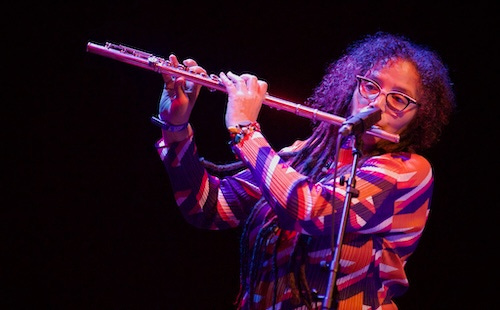
Nicole Mitchell is an award-winning flautist, composer, bandleader, and educator. She has taught at colleges and universities around the United States. Her book, The Mandorla Letters: for the hopeful, was published in 2022.
A mandorla is the shape created where two circles overlap; Mitchell uses the figure to symbolize a shared space in the union of two opposing worlds, where the potential for disruption awakens new possibilities.
As she writes in The Mandorla Letters, “Visionary art does not appear practical, but it can help us fly.”1
My mother… loved to paint and to write creatively, and… was constantly expressing ideas of other worlds through her art. She impressed that upon me—how to take blankness or nothingness and create a combination of what’s familiar and what’s unknown, or what’s never existed before, with creativity… like working with that idea of a bridge. There’s where we are, there’s how we perceive our reality. Then there’s always those special moments, whether they be of fear or of inspiration, when it’s like the world has suddenly cracked open and it’s way more than we ever imagined… Improvisation is a practice that allows you … to actually experience the greatness of possibility and surprise and spontaneity.
With composing there’s the idea of creating music that can be transformative and inspirational… I also reflect on history and reality in my work, but what I really want to do is get you to think about some other possibility. I seek to be inspired by artists that try to do more visionary things with their work, rather than just to be reflective.
I have a lot of hope and love for humanity, but I’m also being real in observing the scary side of humanity—the fact that as human beings we really don’t cherish life. …We’ve got all this technology, but spiritually we haven’t really evolved beyond the idea of domination versus making connections and partnerships. We need to focus on sharing and be more holistic.
I sing into the flute, I sing with the flute, I sing and then I just play the flute. So I have all these combinations of the relationship between the voice and the flute. Part of that comes from the desire to leave evidence that a woman was here… Even without a video or picture of that music, I want to leave that mark, that aesthetic of whatever is coming through me as a woman, as a channel for that feminine energy.2
Music is supposed to be fun so why would I limit myself? Endless possibilities is my mantra for creativity. The idea is that you can create something familiar and bridge that with the unknown.3
I moved to Chicago in my early 20s, but it wasn’t until I was almost 30 that I started fixating on a concept that I call “the edge of beauty.”…the unknown is a doorway into other dimensions or states of being. What would playing ugly sound like? Could I embrace “ugliness” and find something I could deem beautiful? How can my voice become a part of my instrument?
…[in my youth] I was ugly because I was unkempt, ugly because I was Black, ugly because I was not like everyone else in that population. A sound can represent identity, and I wanted the sound of the flute to wholly represent my being – even the parts that were for some reason scary to others, or scary to myself. Utilizing my voice with the flute is probably the most clear way I’ve found to do this, as my voice is a similar range to the instrument and I can do harmonies with the instrument (pleasing) or I can growl, or change the sound into something not familiar. This is also a rebellion from the stereotype of flutes being “pretty” or “delicate.”
I can refer back to that story of my suburban racist childhood as the time that I learned that all people really want the same things – they want attention, acceptance, to be cared about, to find peace in their lives – no matter what political affiliation they have. My music is an energy more than it is a message, and hopefully that energy can touch anyone in a positive way.… We are all connected, and it’s the division (race, class, religion, etc.) that is an illusion created by the immaturity of our collective minds.
I believe music has the power to be a healing force, most definitely. It can also be destructive. It has to do with one’s intent as an artist.4
Great post. She’s so inspiring. Can’t wait to see her perform again.