
What Matters?
How do we live with knowing that we can't save the world? How do we keep trying?

From the archives: October 30, 2022
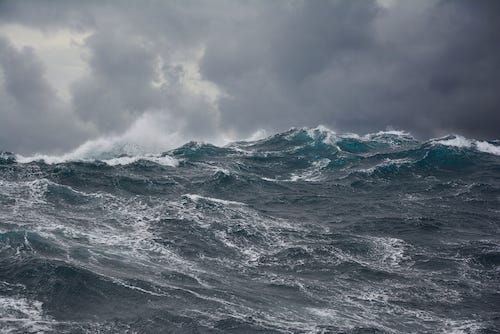
I was with friends on Bear Island, off the North Carolina coast. Separately, we explored the beach. I was a long way from the rest of the group when I decided to swim. I made my way through the rough surf to deeper water. I floated and paddled around in the swells. When I tried to return to shore, I couldn't. For every crest of a wave that propelled me toward land, an undertow pulled me back out. Forward, then back. Forward, then back. I wasn't making any progress. My companions were tiny figures far down the beach.
I had no choice but to struggle, forward and back again, forward and back again, until, finally, I was able to press my feet against the bottom and wrest myself away from the ocean. I staggered out onto the hot sand. No one saw me. If I had been lost, no one would have known where or how.
Great tides are moving across the earth: the suppression of democracy; the rise of fascism; the destruction wrought by climate change and war. Although I would really prefer not to think about it, avoiding the global picture isn't tenable.
Yet, keeping myself informed is agonizing. I feel as helpless as a woman struggling not to be pulled under the surface of the sea.
How does one person make a difference? How does one person matter?
On a small scale, it's as simple as visiting a sick friend, or sending them a card, or calling them, or walking their dog. But even the people you know best are mysteriously complicated. It takes wisdom to know when and how to make a difference, and not just put your foot in it. Confining your reach to the same Zip code can still reveal problems impossible to solve: wanting a friend not to be sad; wanting a coworker not to be so unnecessarily difficult; wanting a situation to resolve simply and successfully when the participants are not simple; pushing against someone else's obstinacy with your own lifelong pattern of stubbornness.
Even if I ignored big issues, stopped reading the news, stopped listening to the radio, I would still have the opportunity for intimate knowledge of the individuals in my community, and all the kindness, selfishness, altruism, greed, pettiness, and profundity of the world writ small.
Once upon a time, Avalokiteshvara saw the suffering of all sentient beings. He wept and resolved to free every being in the universe from suffering. He then worked tirelessly until enormous numbers were saved. Encouraged by this, he turned around and saw multitudes more who still suffered. Because the number of suffering beings is infinite, their number had not decreased despite all of Avalokiteshvara's efforts.
Frustrated, he decided to seek only his own happiness. This selfish thought caused his head to shatter into pieces. He pleaded with the Buddha for help.
From the fragments of Avalokiteshvara's fractured skull, the Buddha created eleven heads - ten with benevolent expressions and the eleventh with a wrathful gaze for those who require a sharper message. To help Avalokiteshvara with his labors, the Buddha endowed him with a thousand arms and a thousand eyes, one in the palm of each hand. The eyes see what needs to be done, and the arms carry out the task.
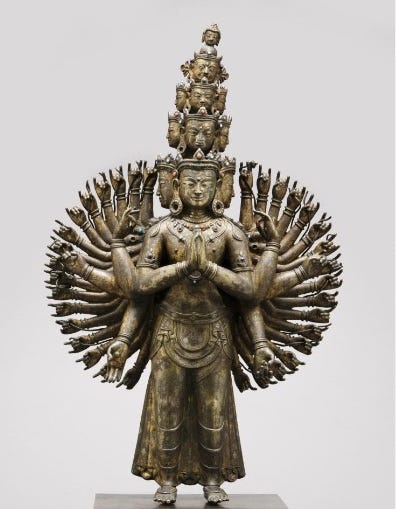
In Buddhism, a bodhisattva is someone who devotes her life to helping all sentient beings. Despite the pain of their "unbearable compassion," bodhisattvas are joyful, because serving the welfare of others brings them the greatest delight.
In order to be an excellent bodhisattva, it's important to find work that uses your talents and that you take joy in doing. Work that brings you joy will be the work where you are most effective.
How do we live with knowing that we can't save the world? How do we keep trying?
It is not your responsibility to finish the work of perfecting the world, but you are not free to desist from it either.
Rabbi Tarfon, Pirke Avot 2:21
The present builds on the work of the past and prepares the ground for the future.
Poignant and powerful.